
Average Cost Per Square Foot to Build a House in 2026
National Average Cost Per Square Foot to Build a House in 2026
The cost per square foot to build a house in 2026 can vary substantially based on location, labor rates, material selections, home design, and finish level. A broad national planning range of approximately $150 to $300 per square foot may be useful for preliminary budgeting, but actual construction costs can fall below or above that range depending on the project.
For a 2,500-square-foot home, that range represents roughly $375,000 to $750,000 in construction costs before land and other expenses that may fall outside the building contract.
Because cost per square foot is only a starting point, a detailed estimate should account for the individual labor, material, equipment, and project-specific requirements that make up the total construction cost.
This guide explains the major factors that affect residential construction costs, regional differences, common cost categories, and how to develop a more realistic project budget.
Follow Us
Stay updated with new tools, tips, and releases.
In This Guide
−- Why the Average Cost Per Square Foot to Build a House Matters in 2026
- Average Cost Per Square Foot to Build a House in 2026
- Cost Per Square Foot to Build a House by Region (2026)
- 2026 Construction Cost Per Square Foot Breakdown
- Key Factors That Drive Your Construction Cost Per Square Foot
- How to Calculate Construction Cost Per Square Foot
- Why Detailed Estimates Matter
- 7 Ways to Control Construction Costs in 2026
- Frequently Asked Questions
Why the Average Cost Per Square Foot to Build a House Matters in 2026
Construction cost per square foot provides a useful starting point for comparing projects and developing a preliminary building budget. However, the final cost of a home depends on many variables, including location, design, labor rates, material selections, site conditions, and the level of finishes.
Knowing the average cost per square foot to build a house can help you:
- Develop a preliminary budget before finalizing the design and specifications.
- Compare construction options using a consistent baseline.
- Evaluate contractor proposals while considering differences in scope, materials, allowances, and exclusions.
- Identify major cost variables that may require more detailed estimating before construction begins.
Average Cost Per Square Foot to Build a House in 2026
| Home Type | Average Cost Per Sq Ft | Typical 2,500 sq ft Total |
|---|---|---|
| Basic / Builder-Grade | $150 – $200 | $375,000 – $500,000 |
| Mid-Range Custom | $200 – $280 | $500,000 – $700,000 |
| High-End / Luxury | $280 – $450+ | $700,000 – $1,125,000+ |
Sources: Angi (Feb 2026), NAHB 2025 Cost of Construction Survey projected forward, ReAlpha February 2026 analysis.
For preliminary planning, basic and mid-range homes may fall between approximately $150 and $280 per square foot, while high-end or luxury construction can exceed $450 per square foot. Actual costs vary considerably by location, design, materials, labor rates, site conditions, and contractor requirements.
Cost Per Square Foot to Build a House by Region (2026)
| Region | Avg Cost Per Sq Ft | Example 2,000 sq ft Home |
|---|---|---|
| Midwest | $100 – $160 | $200,000 – $320,000 |
| South | $109 – $190 | $218,000 – $380,000 |
| West | $131 – $350 | $262,000 – $700,000 |
| Northeast | $155 – $350 | $310,000 – $700,000 |
Construction costs can vary substantially within each region, particularly in high-cost metropolitan and coastal markets. Custom homes, complex designs, premium finishes, challenging site conditions, and higher local labor costs can push per-square-foot costs well above broader regional ranges.
2026 Construction Cost Per Square Foot Breakdown
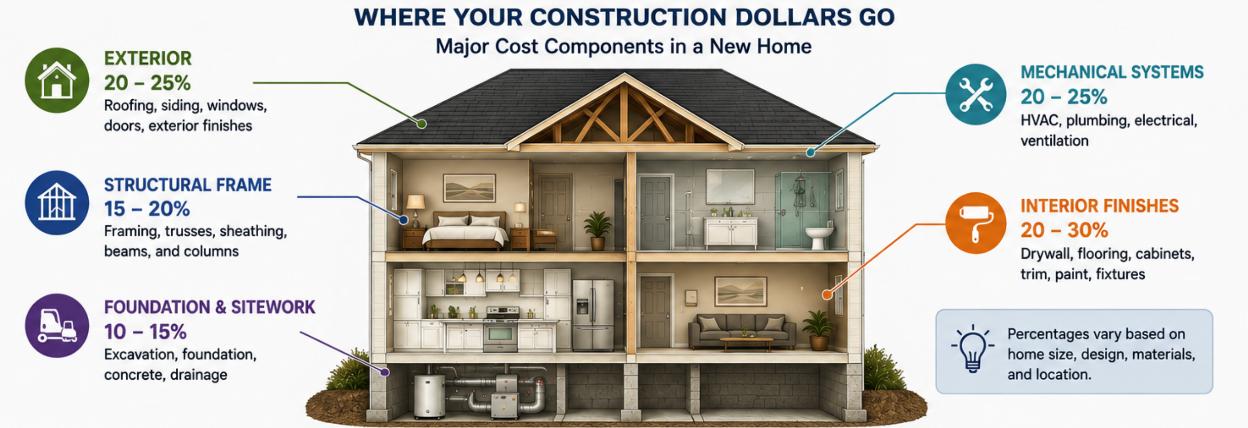
Construction costs are distributed across several major building categories. The ranges below illustrate how different components can contribute to the overall cost of a new home.
Planning Tip: A detailed scope and estimate can help identify project requirements before construction begins. Changes in design, materials, site conditions, or project scope can still affect the final cost.
Key Factors That Drive Your Construction Cost Per Square Foot
- Location – Labor rates, material pricing, permitting requirements, building codes, and market conditions vary by location.
- Home Size & Design Complexity – Building size, rooflines, floor plans, structural requirements, and architectural details can significantly affect cost per square foot.
- Materials – Builder-grade, mid-range, and premium material selections can create substantial differences in overall construction cost.
- Labor Availability – Local labor availability and prevailing trade rates can affect both project cost and scheduling.
- Site Conditions – Sloped lots, difficult access, poor soil conditions, drainage requirements, and other site-specific conditions can increase construction costs.
- Finishes & Upgrades – Cabinetry, countertops, flooring, fixtures, appliances, and technology upgrades can substantially affect the final budget.
- Permits & Impact Fees – Permit, inspection, utility, and impact-fee requirements vary by jurisdiction and project.
How to Calculate Construction Cost Per Square Foot
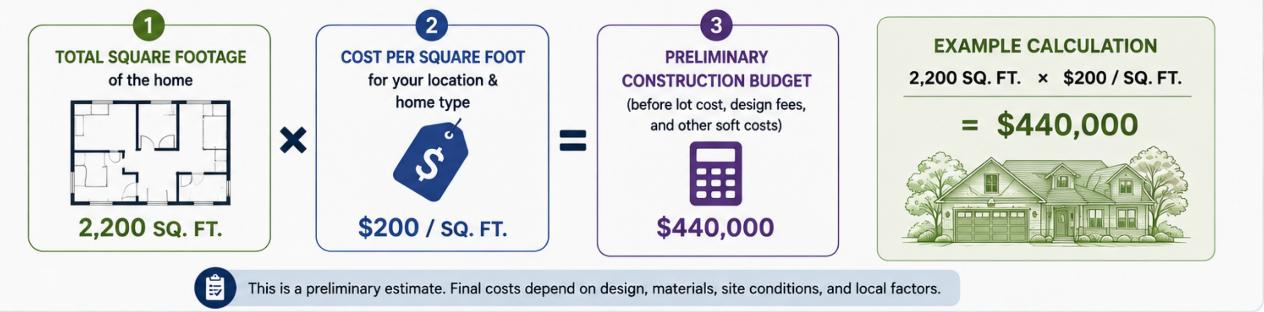
Determine the planned square footage and home design.
- Establish a realistic local cost range based on location, construction quality, labor, and material requirements.
- Multiply the square footage by the estimated cost per square foot to develop a preliminary construction budget.
- Account for project-specific costs such as site conditions, permits, design changes, material selections, and other variables not adequately reflected in the initial rate.
- Develop a detailed scope and estimate before relying on the preliminary cost-per-square-foot calculation for project decisions.
Example: If a preliminary planning rate is $200 per square foot for a 2,200-square-foot home, the initial construction estimate would be $440,000. This calculation is a starting point only; the final budget should account for the project's actual scope, location, materials, labor, site conditions, permits, and other project-specific requirements.
Why Detailed Estimates Matter
A cost-per-square-foot calculation is useful for preliminary budgeting, but it cannot account for every component of a construction project. Roofing, siding, gutters, structural components, interior finishes, and other building systems each involve specific quantities, materials, labor, and project requirements.
Detailed, line-item estimating provides a clearer picture of the work involved by breaking the project into individual components rather than relying solely on a broad square-foot allowance. For restoration and insurance-related projects, this level of documentation can also help contractors identify scope items and prepare more complete estimates.
7 Ways to Control Construction Costs in 2026
- Simplify the design. Complex rooflines, layouts, structural details, and architectural features can increase labor and material requirements.
- Evaluate the building site carefully. Grading, access, drainage, soil conditions, utilities, and foundation requirements can significantly affect construction costs.
- Establish material selections early. Making major product and finish decisions before construction can help develop a more complete budget.
- Compare detailed contractor proposals. Review scope, quantities, materials, allowances, exclusions, and other assumptions rather than comparing price alone.
- Plan for project-specific variables. Permits, site conditions, design changes, material availability, and other unforeseen requirements can affect the final cost.
- Document the scope thoroughly. A detailed scope helps identify the labor, materials, and individual components that need to be included in the estimate.
- Use cost per square foot as a planning tool. Develop a detailed estimate before making final construction or budgeting decisions.
Frequently Asked Questions
What is the average cost per square foot to build a house in 2026?
A broad planning range of approximately $150 to $300 per square foot may be useful for many projects, but actual costs vary significantly by location, home design, materials, labor rates, site conditions, and finish level. High-end construction can exceed this range.
Is it cheaper to build or buy a house in 2026?
It depends on the local housing market, land costs, home design, construction costs, and the price and condition of comparable existing homes. Neither option is universally less expensive.
How much does labor affect construction cost per square foot?
Labor can represent a significant portion of construction costs, but the percentage varies by project, location, trade, design, and material selections. A detailed estimate provides a more useful project-specific calculation than applying a single national labor percentage.
Can I build a house for under $150 per square foot in 2026?
It may be possible in some markets and for certain projects, particularly with simpler designs and economical material selections. However, location, site conditions, labor rates, permits, utilities, and project specifications can push costs above that level.
What is the biggest limitation of using cost per square foot to estimate a house?
Cost per square foot is a broad budgeting tool that cannot account for all of the variables affecting an individual project. A detailed estimate based on the actual scope, quantities, materials, labor, and project conditions provides a more complete basis for budgeting.
0 Comments